Iran protests continue with 544 people killed, activists say
Sunday marked the fifteenth day of protests.
LONDON -- The death toll from mass protests in Iran has risen to 544, according to data compiled by the U.S.-based Human Rights Activists News Agency (HRANA) on Sunday.
At least 10,681 people have been arrested, according to HRANA. Protests have taken place at 585 locations across the country, in 186 cities, spanning all 31 provinces, according to activists.
The HRANA data relies on the work of activists inside and outside the country.
ABC News cannot independently verify these numbers. The Iranian government has not provided any death tolls during the ongoing protests.
President Donald Trump told reporters aboard Air Force One Sunday night that it "looks like" Iran may have crossed the administration’s red line and the U.S. military has "strong options" at its disposal.
"We’ll make a determination," he said.
Trump has repeatedly warned Tehran against the use of force to suppress the protests. On Saturday, Trump wrote on social media, "Iran is looking at FREEDOM, perhaps like never before. The USA stands ready to help!!!"
According to a U.S. official, the president will be briefed Tuesday to review possible U.S. responses to the situation in Iran.
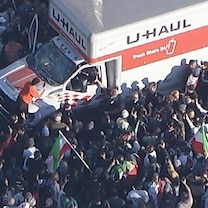
Video footage shot by locals and posted to social media appeared to show thousands of people protesting in Tehran's Punak Square on Saturday night despite reported efforts by government security forces to disperse crowds. Elsewhere, videos showed large crowds gathered in the northeastern city of Mashhad.

The Iranian government has not released detailed statistics on casualties sustained among protesters. The state-aligned Tasnim news agency reported on Sunday that 109 security personnel had been killed in the protests.
HRANA and other human rights groups reported widespread and sustained internet outages across the country as the protests spread. Online monitoring group NetBlocks said early on Sunday that Iran's "internet blackout" had surpassed 60 hours.
Protests have been spreading across the country since late December. The first marches took place in downtown Tehran, with participants demonstrating against rising inflation and the falling value of the national currency, the rial.
As the protests spread, some have taken on a more explicitly anti-government tone, with some protesters chanting slogans including "student, be the voice of your people," and "death to Islamic Republic."
The theocratic government in Tehran -- headed by Supreme Leader Ayatollah Ali Khamenei -- moved to tame the protests, with security forces reportedly using tear gas and live ammunition to disperse gatherings.
Khamenei and top Iranian officials have said they are willing to engage with the economic grievances of protesters, though have also framed the unrest as driven by "rioters" and sponsored by foreign nations, prime among them the U.S. and Israel.
In comments carried by Iranian state media, President Masoud Pezeshkian on Sunday blamed foreign "terrorists" for the protests but also addressed some of the issues that originally brought protesters out onto the streets.
"We are determined, and have decided, to resolve economic problems by any means possible," Pezeshkian said.
Israeli Prime Minister Benjamin Netanyahu said at the start of his weekly cabinet meeting Sunday that "Israel is closely following what is happening in Iran" and the ongoing "demonstrations for freedom" there.
"Israel supports their struggle for freedom and strongly condemns the mass massacres of innocent civilians," Netanyahu further said. "We all hope that the Persian nation will soon be freed from the yoke of tyranny, and when that day comes, Israel and Iran will once again be loyal partners in building a future of prosperity and peace for both peoples."
Dissident figures abroad, meanwhile, have urged Iranians to take to the street and overthrow the government. On Sunday, Iran's exiled Crown Prince Reza Pahlavi addressed protesters in a post to X, saying, "Do not abandon the streets. My heart is with you. I know that I will soon be by your side."

An Israeli official told ABC News on Sunday that Israeli Prime Minister Benjamin Netanyahu and Secretary of State Marco Rubio spoke on Saturday about events unfolding in Iran.
Tehran, meanwhile, has warned against outside intervention. On Sunday, Mohammad Bagher Qalibaf -- the speaker of the Iranian parliament -- said that the U.S. military and Israel will be "legitimate targets" in the event of American strikes on Iran.
ABC News' Victoria Beaule and Jordana Miller contributed to this report.
Related Topics

Popular Reads
ABC News Live